#161 — Copper Crystal Tree
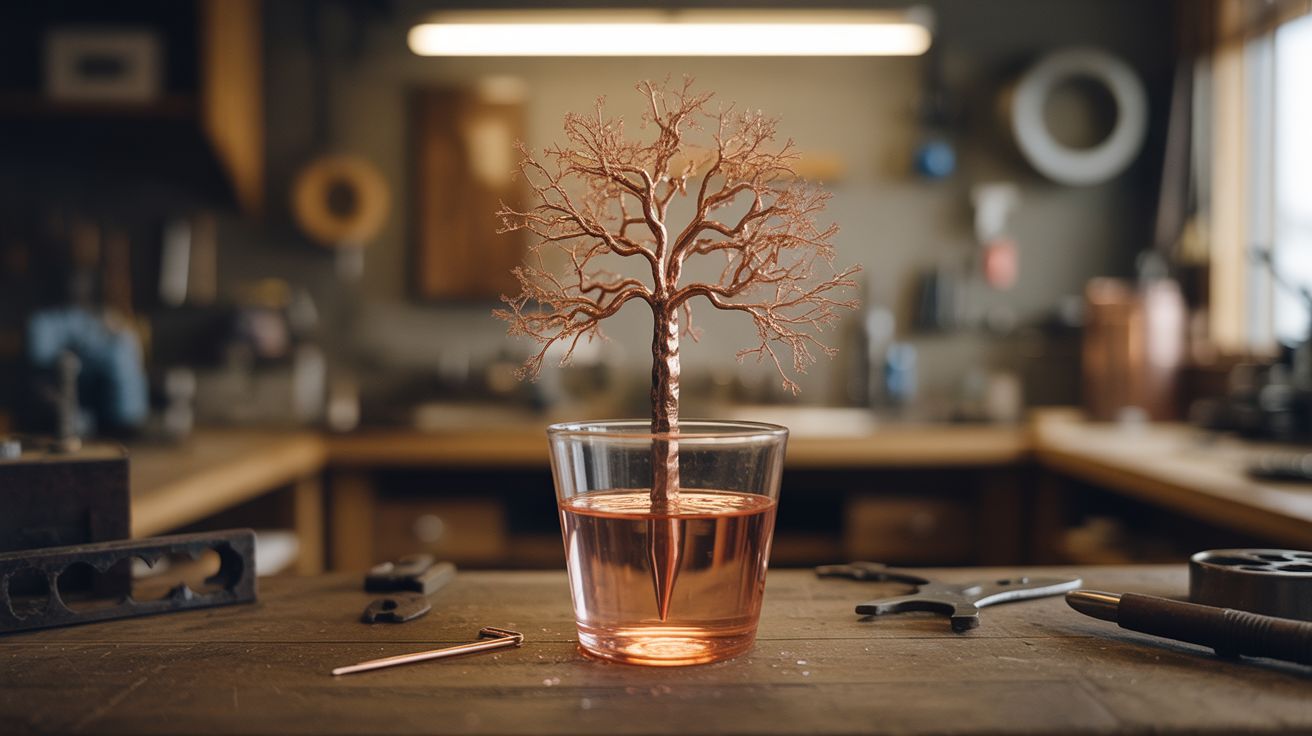
Drop an iron nail in copper sulfate solution — iron displaces copper, depositing dendritic crystal branches over hours. Time-lapse it.
Ratings



🧪 What Is It?
Iron is more reactive than copper in the electrochemical series. When you place an iron nail in a copper sulfate solution, the iron dissolves and copper precipitates out of the solution, depositing on the nail's surface as metallic copper. Over hours, the copper doesn't form a smooth coating — it grows as dendritic crystals that branch outward like a tree. The "tree" is pure copper metal, grown atom by atom through a displacement reaction. Set up a camera for a time-lapse and the growth looks like a living organism. The deep blue solution slowly fades as copper leaves the solution and builds the crystal structure. It's chemistry you can watch happen in real time.
🧰 Ingredients
- Copper sulfate — 2-3 tablespoons (hardware store as root killer)
- Iron nail — clean, ungalvanized (hardware store)
- Glass jar or beaker — for a clear view of the growth (kitchen, lab supply)
- Warm water (tap)
- Camera + tripod — for time-lapse (already own)
- Sandpaper — to clean the nail (hardware store)
🔨 Build Steps
- Prepare the solution. Dissolve 2-3 tablespoons of copper sulfate in a glass jar of warm water. Stir until fully dissolved. The solution should be a vivid blue color. More concentrated = faster growth but coarser crystals.
- Clean the nail. Sand the iron nail with fine sandpaper to remove any coating, oxide, or grease. A clean iron surface is essential for the reaction to start evenly. Handle the cleaned nail with clean hands or tweezers.
- Suspend the nail. Lower the clean iron nail into the copper sulfate solution. You can lay it on the bottom, lean it against the jar wall, or suspend it on a string from the rim for the best visual effect.
- Watch the displacement. Within minutes, you'll see the nail's surface turn copper-colored as metallic copper deposits. Over the next 1-6 hours, dendritic copper crystals begin to branch outward from the nail's surface, growing like a metallic tree.
- Set up the time-lapse. Position a camera on a tripod aimed at the jar. Set it to capture one frame every 30-60 seconds. Over 6-12 hours, you'll have footage of the copper tree growing from nothing. Backlighting the jar makes the blue solution and copper crystals pop on camera.
- Observe the color change. As copper leaves the solution and deposits on the nail, the blue color fades (copper sulfate is blue; iron sulfate is pale green). The nail itself gets smaller as iron dissolves. Mass is conserved — iron atoms leave, copper atoms arrive.
- Harvest the crystal. Once growth has slowed (usually 12-24 hours), carefully remove the nail and its copper crystal tree from the solution. Rinse gently — the dendritic crystals are fragile. Let it dry.
- Preserve the crystal. Spray with a thin coat of clear lacquer to prevent the copper from oxidizing. Display in a shadow box or on a stand. The crystal structure is beautiful under a magnifying glass, showing fractal branching at every scale.
⚠️ Safety Notes
- Copper sulfate is toxic if ingested. Wear gloves when handling the solution. Do not use drinking glasses — label the jar clearly. Keep away from children and pets. Dispose of the spent solution responsibly (not down the drain).
- The reaction produces iron sulfate in solution, which can stain surfaces greenish-brown. Place the jar on a tray to catch any drips.
- Do not use galvanized (zinc-coated) nails. The zinc reacts preferentially and contaminates the copper deposit, producing a messy gray mass instead of clean copper crystals.