#213 — Bleach Crystal Garden
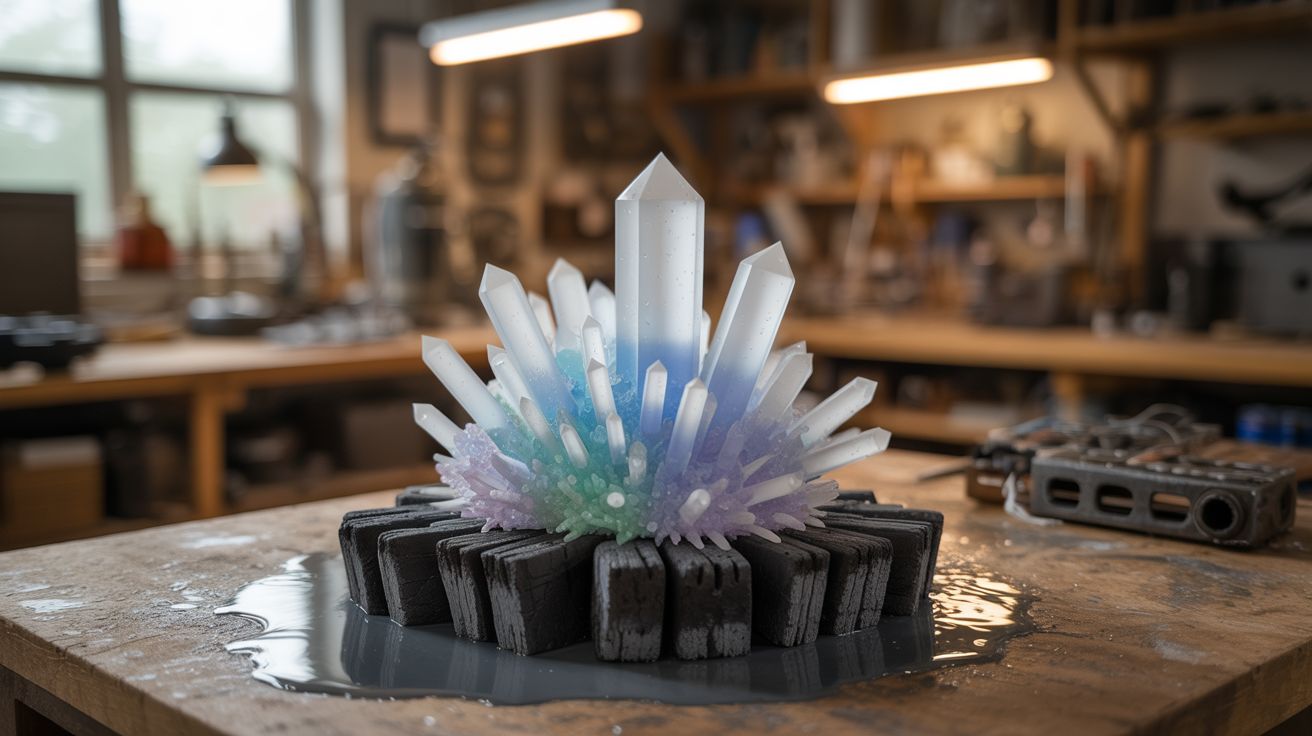
Bleach, liquid bluing, ammonia, and water dripped on charcoal briquettes. Come back in a few hours and you’ve got an alien landscape of delicate white and colored crystals growing right out of the charcoal.
Ratings



🧪 What Is It?
Crystal gardens have been a staple of kitchen science since the 1940s, and for good reason — they look absolutely otherworldly for something made from stuff under your sink. The recipe is deceptively simple: mix bleach, Mrs. Stewart’s liquid bluing (a laundry product that contains colloidal iron particles), household ammonia, and water in equal parts. Pour this mixture over charcoal briquettes sitting in a shallow dish. Then walk away and let capillary action and evaporation do their thing.
Here’s what’s happening at the molecular level. The porous charcoal acts like a wick, drawing the liquid mixture upward through its tiny channels. As water evaporates from the surface, it leaves behind a supersaturated solution of salts. The bluing particles provide nucleation sites — microscopic anchors where crystals begin to form. The result is a fractal-like growth of delicate, branching salt crystals that look like coral, snowflakes, or alien fungus depending on the conditions. The crystals are fragile — a stiff breeze will destroy them — but they keep growing for days as long as you keep feeding the base with fresh solution.
The really fun part is adding color. Drop food coloring directly onto the charcoal before or after pouring the solution, and the crystals grow in vivid colors. Use different colors on different briquettes for a full rainbow garden. The crystals form fastest in dry, warm environments (low humidity speeds evaporation), so running this near a heating vent or in a sunny window produces the most dramatic results. Within 6-12 hours you’ll have visible crystal formations, and by 24-48 hours you’ll have a full crystal landscape that looks like something from a nature documentary about deep-sea hydrothermal vents.
🧰 Ingredients
- Charcoal briquettes — plain, not self-lighting (the lighter fluid inhibits crystal growth) (grocery store, ~$3 for a bag)
- Mrs. Stewart’s Liquid Bluing — the classic laundry bluing agent (grocery store or online, ~$4)
- Household bleach — standard 6% sodium hypochlorite (under the sink, ~$2)
- Household ammonia — clear, not sudsy (cleaning aisle, ~$2)
- Water — tap is fine (free)
- Food coloring — assorted colors (grocery store, ~$3)
- Shallow dish or pie pan — disposable aluminum works great (dollar store, ~$1)
- Measuring spoons — for equal-part mixing (existing kitchen supplies)
🔨 Build Steps
-
Arrange the charcoal. Place 4-6 charcoal briquettes in a single layer in your shallow dish. Break a couple in half for varied terrain — the irregular surfaces give crystals more interesting shapes. Don’t pack them tight; leave a little space between pieces for solution to pool.
-
Mix the solution. Combine 2 tablespoons each of liquid bluing, bleach, ammonia, and water in a separate container. Stir gently. The proportions don’t need to be exact — this is forgiving chemistry. Some recipes call for adding 1 tablespoon of salt for denser crystal growth.
-
Add color. Drop 3-5 drops of food coloring directly onto each charcoal briquette. Use different colors on different pieces for a multicolored garden. The food coloring gets wicked up with the solution and incorporated into the crystal structure.
-
Pour the solution. Slowly pour the mixed solution over the charcoal, making sure each piece gets wet. Don’t flood the dish — you want the charcoal damp, not submerged. Pour any remaining solution into the bottom of the dish. The charcoal will wick it up over time.
-
Place and wait. Set the dish in a warm, dry spot with good air circulation — near a heating vent, in a sunny window, or in front of a small fan. The faster the water evaporates, the faster crystals form. Don’t move or bump the dish once crystals start growing — they’re extremely fragile.
-
Feed the garden. After 24 hours, add another batch of solution (2 tablespoons each of bluing, bleach, ammonia, and water) to the bottom of the dish — not directly on the crystals. This keeps the wicking process going and fuels continued crystal growth. You can keep feeding it for a week or more.
-
Observe and photograph. Crystal growth is visible within 6-12 hours. By 24 hours you’ll have significant formations. By 48-72 hours the garden should be spectacular. Take photos — these structures are too fragile to preserve long-term. A macro lens or phone macro mode reveals incredible detail.
⚠️ Safety Notes
- You’re mixing bleach and ammonia in small quantities. In large quantities, this produces toxic chloramine gas. The amounts used here (tablespoons, not cups) produce negligible fumes, but work in a ventilated area as a precaution. Do not mix large batches.
- Bleach irritates skin and eyes. Wear gloves if you have sensitive skin, and don’t rub your eyes during the process. Wash hands after handling.
- The crystals are not edible. They contain salt, iron compounds, and bleach residue. Keep away from pets and small children who might taste them.
- The finished crystal garden is extremely fragile. Don’t display it where it might get knocked over — the crystals shatter at the slightest touch and the liquid base will stain surfaces.