#327 — Sugar Smoke Bombs
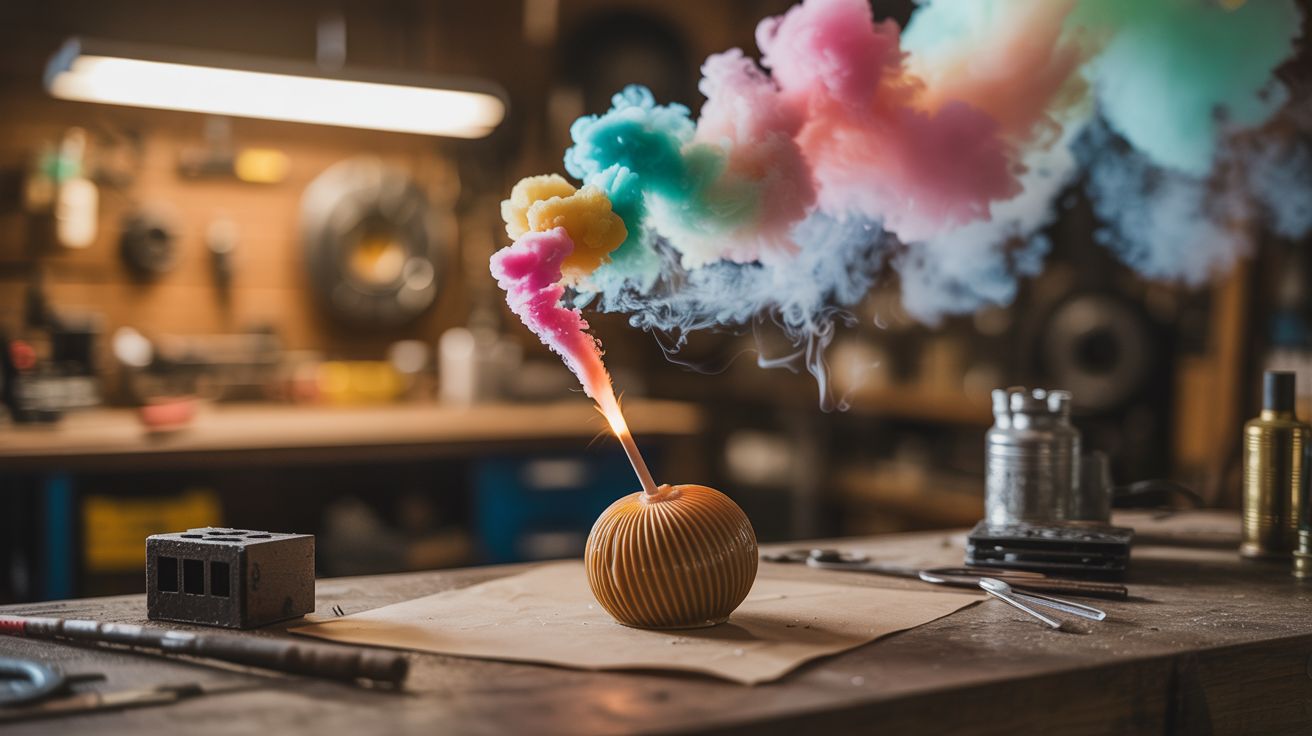
Potassium nitrate plus sugar, cooked to caramel, shaped and fused. Light the fuse and watch dense colored smoke pour out for 30-60 seconds. The backyard pyrotechnic classic.
Ratings





🧪 What Is It?
KNO3 smoke bombs are the entry point to amateur pyrotechnics, and for good reason — the ingredients are dirt cheap, the process is basically candy-making, and the results are genuinely impressive. The chemistry is straightforward: potassium nitrate (KNO3, also known as saltpeter) is an oxidizer that provides oxygen to sustain combustion. Sugar (sucrose) is the fuel. When you melt them together, you get a caramel-like substance called “rocket candy” in the hobby rocketry world. Light it, and it burns at a controlled rate, producing a massive volume of thick white smoke made of potassium carbonate particles, CO2, water vapor, and various organic aerosols.
The cooking process is critical and is where most beginners mess up. You’re heating KNO3 and sugar together on a stove at low-medium heat, stirring constantly, until the sugar melts and the mixture becomes a smooth, peanut-butter-colored slurry. The key word is LOW heat. Too much heat and the sugar ignites while you’re stirring it on the stove — which is exactly as exciting and dangerous as it sounds. Patience wins here. Low and slow, stirring constantly, watching the color change from white powder to golden caramel.
Once the mixture is smooth and liquid, you pour it into molds — cardboard tubes, tin cans, or rolled paper cylinders. Insert a fuse (a piece of visco cannon fuse or even a homemade KNO3-soaked string), let it cool and harden, and you’ve got a smoke bomb that would make a paintball field jealous. For colored smoke, add organic dye powder to the mixture before pouring — red, blue, green, purple, whatever you want. The smoke density is remarkable: a single smoke bomb the size of a toilet paper tube can obscure a 50-foot area for a solid minute.
🧰 Ingredients
- Potassium nitrate (KNO3) — stump remover brand is pure KNO3 (garden center or hardware store, ~$5)
- Granulated sugar — plain white table sugar (grocery store, ~$2)
- Organic dye powder — for colored smoke (optional but worth it) (online pyrotechnics supplier, ~$5-10)
- Cardboard tubes — toilet paper tubes or paper towel tubes cut to size (free)
- Aluminum foil — for wrapping the finished bombs (kitchen drawer, free)
- Visco safety fuse — green waterproof cannon fuse (online pyrotechnics supplier, ~$5 for 20 feet)
- Old cooking pot — one you don’t mind dedicating to chemistry forever (thrift store, ~$2)
- Wooden spoon — for stirring (existing or dollar store, ~$1)
- Kitchen scale — for measuring ratios (existing, or ~$10)
- Duct tape — for sealing tube ends (existing)
🔨 Build Steps
-
Measure the mixture. Weigh out a 3:2 ratio of KNO3 to sugar — 60g KNO3 to 40g sugar is a good starting batch. This ratio burns slowly and produces maximum smoke. More KNO3 makes it burn faster and hotter with less smoke. More sugar makes it harder to ignite and smokier. The 3:2 ratio is the sweet spot (pun intended).
-
Cook the mixture. Combine KNO3 and sugar in your dedicated pot. Place on the stove at LOW heat — the lowest setting that still produces warmth. Stir constantly with the wooden spoon. The sugar will gradually melt and dissolve the KNO3. The mixture transitions from white powder to a wet sand consistency to a smooth, golden-brown liquid. This takes 10-15 minutes. Do not rush it. If you see any wisps of smoke rising from the pot, you’re too hot — remove from heat immediately.
-
Add dye (optional). When the mixture is smooth and liquid, remove from heat and quickly stir in organic dye powder — about 1 tablespoon per 100g batch. The dye dissolves into the mixture. More dye = more vivid colored smoke. Red and orange dyes work best; blue and green are harder to get dense color from. Stir thoroughly for uniform color.
-
Prepare the molds. While the mixture cools, seal one end of each cardboard tube with a disc of cardboard and duct tape. Poke a hole in the center of the sealed end for the fuse. Thread a 3-inch piece of visco fuse through the hole so 1 inch protrudes outside and 2 inches will be inside the smoke composition.
-
Pour and pack. Quickly pour or spoon the warm mixture into the prepared tubes, packing it gently around the fuse. Don’t pack too tightly — some porosity helps the burn propagate evenly. Fill tubes to within 1/2 inch of the top. The mixture hardens as it cools, within 5-10 minutes at room temperature.
-
Seal and finish. Once hardened, seal the open end of the tube with aluminum foil, leaving just the fuse protruding from the bottom. Wrap the entire body in aluminum foil for structural integrity. The foil also reflects heat inward, making the burn more complete and the smoke denser.
-
Light and enjoy. Set the smoke bomb on a non-flammable surface (concrete, gravel, bare dirt). Light the fuse and step back 10 feet. The bomb should start producing thick smoke within 5-10 seconds of the fuse burning down to the composition. Burn time is 30-60 seconds depending on size. Smoke output is impressive — perfect for photography, airsoft, or just looking like a movie scene in your backyard.
⚠️ Safety Notes
Spicy Level 3 build. Read the Safety Guide and Chemical Safety, Fire & Pyro Safety before starting.
- The cooking step is the most dangerous part. KNO3/sugar can ignite if overheated, and once it ignites, it cannot be extinguished with water (the KNO3 provides its own oxygen). Cook on the LOWEST heat setting, stir constantly, and keep a metal lid nearby to smother the pot if ignition occurs. Never walk away from the pot.
- Perform all cooking outdoors or in a very well-ventilated area on an electric stove. Do NOT use a gas stove — the open flame is an ignition risk.
- Smoke bombs produce very dense smoke that is an irritant in high concentrations. Do not use in enclosed spaces. Stand upwind when lighting.
- Check local regulations regarding smoke-producing pyrotechnic devices. They may be legal to make but illegal to use in certain areas.
- Store finished smoke bombs in a cool, dry place away from heat sources. They are stable at room temperature but will ignite readily from an open flame.