#034 — Jacob's Ladder
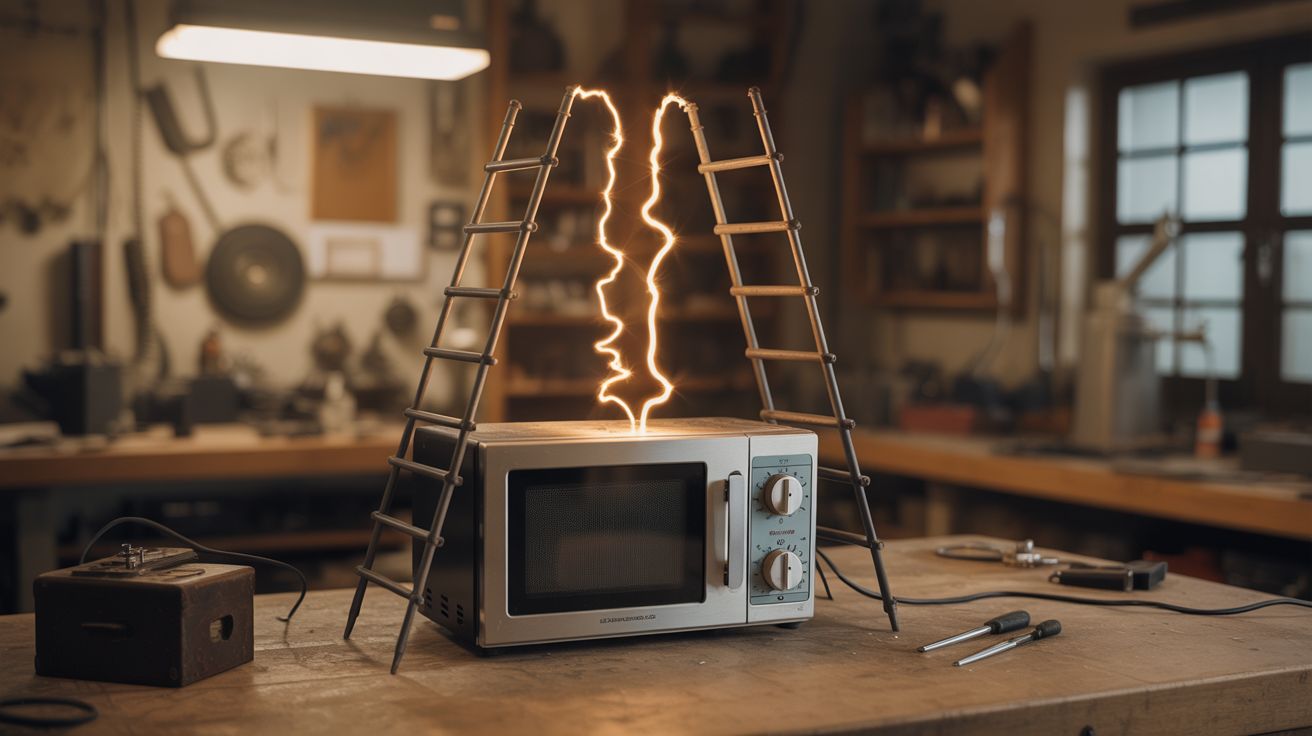
Two diverging metal rods plus a microwave oven transformer equals a rising arc of electricity that looks like it belongs in a 1930s horror movie.
Ratings






🧪 What Is It?
A Jacob's Ladder is the most iconic high-voltage display ever built. Two metal rods spread apart from bottom to top in a V shape, powered by a high-voltage transformer. An arc strikes at the narrow bottom where the rods are closest, then the heated air rises (hot air rises — basic convection), carrying the arc upward along the diverging rods. As the arc stretches and the gap widens, it eventually breaks. A new arc immediately forms at the bottom and the cycle repeats. The result is a continuous stream of arcs climbing the rods like a ladder.
It's the prop from every mad scientist movie ever made, and it's genuinely one of the simplest high-voltage builds you can do. A microwave oven transformer provides the voltage. Two copper or steel rods provide the path. That's basically it.
🧰 Ingredients
- Microwave oven transformer (MOT) — provides ~2000V AC (dead microwave, e-waste)
- Copper or steel rod x2 — 1/4" diameter, 18"-24" long (hardware store)
- Non-conductive base — thick wood block, cutting board, or acrylic sheet (hardware store)
- Power cord with plug (old appliance)
- Power switch — mains-rated toggle switch (hardware store, electronics supplier)
- Inline fuse — 15A, for the primary side (hardware store)
- Insulated standoffs or blocks — to mount the rods to the base (hardware store)
- Wire nuts and electrical tape (hardware store)
🔨 Build Steps
- Recover the MOT. Remove the transformer from a dead microwave. Discharge the microwave's capacitor first — short the terminals with an insulated screwdriver. Unbolt the transformer. Leave both the primary and secondary windings intact — unlike the spot welder build, you want the full high-voltage output here.
- Remove the magnetic shunts (optional). The shunts between the primary and secondary limit current. Removing them increases the available current and makes for fatter, louder arcs. However, this also increases the danger — a shunt-less MOT can deliver lethal current. For a first build, leave the shunts in.
- Bend the rods. Bend each rod into an L shape at the bottom — the horizontal portion bolts to the base, and the vertical portion forms the ladder. The two rods should be about 1/4" apart at the bottom and 4"-6" apart at the top. The wider the spread at the top, the taller the arc travels before breaking.
- Mount the rods to the base. Bolt the horizontal sections of the rods to the non-conductive base using insulated standoffs. The rods must be rigidly mounted — vibration from the arc will make loose rods buzz annoyingly. Keep the rods at least 6" from the transformer.
- Wire the secondary. Connect each of the MOT's secondary (high-voltage) output wires to one of the rods. Use insulated connectors and keep the connections as short as possible. The secondary output is approximately 2000V AC — it will arc to anything grounded within range.
- Wire the primary. Connect the power cord through the fuse and switch to the MOT's primary winding. The primary is the winding with the thicker wire and fewer turns. Double-check which winding is which — connecting mains to the secondary would produce only a few volts on the primary and accomplish nothing.
- First power-on. Stand back, flip the switch, and watch. An arc should strike at the bottom of the V and begin climbing. If no arc forms, the bottom gap is too wide — bend the rods closer together. If the arc stays at the bottom and doesn't climb, the rods may be too parallel — increase the spread at the top.
- Tune the geometry. Adjust the rod angle to change how fast the arcs climb and how tall they get. A steeper V makes arcs climb faster and break sooner. A shallower V gives slower, taller arcs. The sweet spot depends on your MOT's voltage and current.
⚠️ Safety Notes
Spicy Level 5 build. Read the Safety Guide and High Voltage Safety before starting.
- A microwave oven transformer outputs approximately 2000V at up to 500mA — well above the lethal threshold. This is the most dangerous build in this category. Never touch the rods, the secondary wiring, or anything connected to the high-voltage side while the unit is powered or for several seconds after power-off. The MOT has enough stored energy in its magnetic field to deliver a lethal shock even after the switch is flipped off.
- The arc produces intense UV light, ozone, and nitrogen oxides. Operate outdoors or in a very well-ventilated space. Do not stare directly at the arc — it can cause arc eye (UV burns to the cornea), similar to welding flash. Safety glasses with UV protection are recommended.
- Keep all flammable materials far from the device. The arc temperature exceeds 5000°F. Paper, fabric, or solvents near the arc will ignite.