#190 — Prince Rupert's Drop
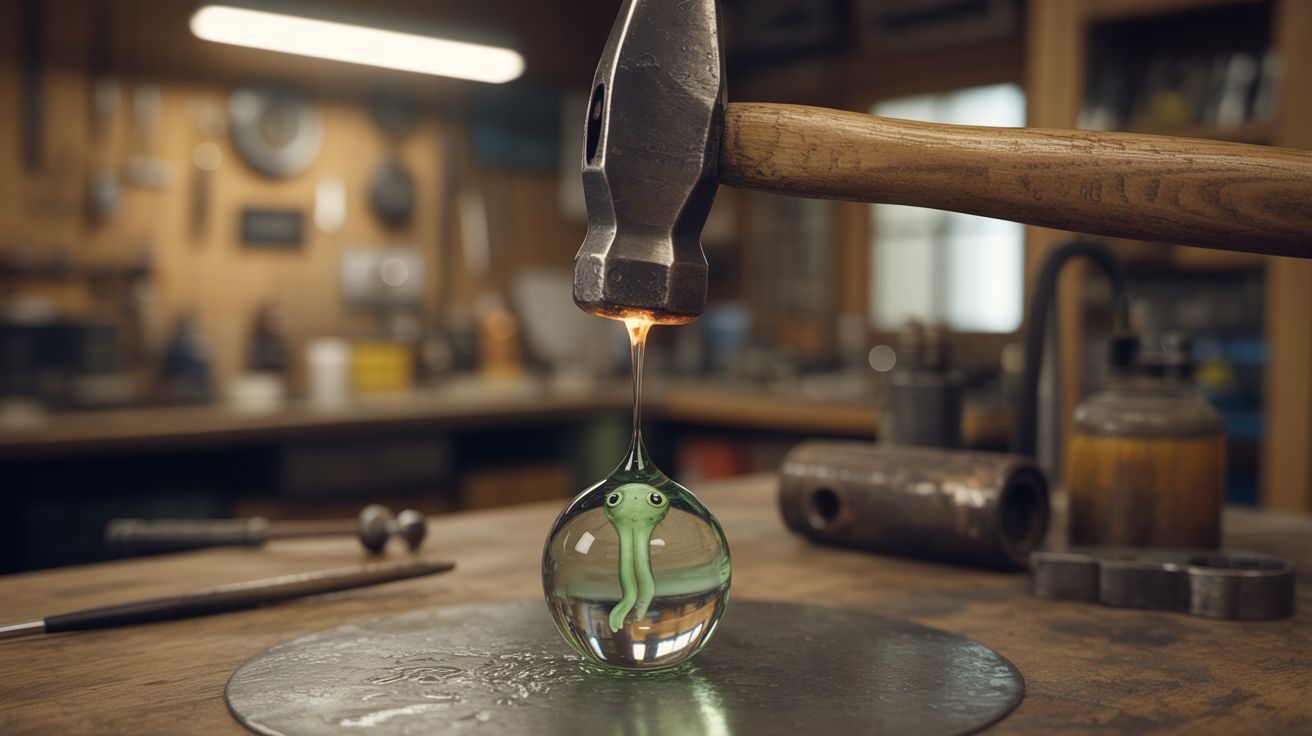
Molten glass dropped in water creates a tadpole that shrugs off a hammer blow — then explodes if you breathe on its tail.
Ratings





🧪 What Is It?
A Prince Rupert's Drop is formed by dripping molten glass into cold water. The outside of the drop solidifies instantly while the inside is still molten. As the interior cools and contracts, it puts the outer shell under enormous compressive stress — the same principle that makes tempered glass strong. The bulbous head can withstand hammer strikes, hydraulic presses, even bullets. But snap the thin tail, and the entire drop explodes into powder in a millisecond as all that stored stress releases at once.
These have been known since the 1600s (Prince Rupert of the Rhine brought them to the English court), and they're still one of the most dramatic demonstrations of internal stress in materials science. Filming the destruction in slow motion at 100,000+ fps reveals a fracture front propagating at nearly a mile per second.
🧰 Ingredients
- Glass rods or broken glass pieces suitable for melting (source: borosilicate rod from Amazon or craft store — $5-10, or soda-lime glass from broken bottles)
- Propane or MAPP gas torch (source: hardware store, ~$15-30)
- Deep bucket or container of cold water (source: your house)
- Safety glasses (mandatory) (source: hardware store)
- Thick leather gloves (source: hardware store)
- Long metal tweezers or pliers (source: craft store or toolbox)
- Hammer or vise for testing the head (source: toolbox)
- Slow-motion camera or phone (source: your phone — 240fps minimum)
🔨 Build Steps
-
Set up the water bath. Fill a deep bucket or metal container with cold water. Room temperature works; ice water gives slightly better results. The container should be at least 12 inches deep so the molten glass has time to solidify into its tadpole shape during the fall.
-
Prepare the glass. Cut a glass rod into 2-3 inch pieces, or gather shards of broken glass. Borosilicate (Pyrex-type) glass makes more durable drops that survive handling better. Soda-lime glass (bottles) works but the drops are more fragile.
-
Melt the glass. Hold a glass piece with long tweezers and heat one end with the torch until it glows orange and forms a molten blob about the size of a marble. Rotate it to keep the blob roughly spherical. The glass should be fully liquid — viscous enough to drip but not stiff.
-
Drop it. Hold the molten glass over the water and let the blob drip in, or tilt the tweezers so it slides off. The glass will plunge into the water, quenching the outside instantly. It should form a tadpole shape — a round head with a thin, curving tail trailing behind it.
-
Retrieve and inspect. Let the drop cool for a minute in the water. Fish it out carefully — the tail is extremely fragile. Examine the drop: the head should be clear or slightly cloudy, perfectly smooth, with a long thin tail that may curve or spiral.
-
Test the head. This is the fun part. Place the head on a hard surface and hit it with a hammer. It shouldn't break. Squeeze it in a vise. Put it under your shoe. The head can take absurd punishment. Film this — the contrast with the next step is what makes the demo legendary.
-
Break the tail. Set up your slow-motion camera. Using pliers, snap the thin tail. The entire drop will explode into fine glass powder in a chain reaction that propagates from the tail through the head. In real time it looks instantaneous. In slow motion, you can see the fracture front racing through the glass.
-
Iterate. Make several drops. They vary in quality — some will have air bubbles or uneven cooling that weakens them. A good drop feels satisfying when you tap the head: a hard, ringing "click." A bad drop sounds dull and may break under light pressure.
⚠️ Safety Notes
Spicy Level 3 build. Read the Safety Guide before starting.
[!WARNING] Glass shrapnel is the primary hazard. When a Prince Rupert's Drop explodes, it sends fine glass powder and small shards in all directions. Always wear safety glasses. Do the tail-breaking step inside a clear container or wrapped in a towel to contain fragments.
- Molten glass burns. Glass at working temperature (800-1000 degrees C) will cause severe burns instantly. Never reach over the water bath when dropping glass. Use long tweezers and keep your face and arms out of the splash zone. Molten glass that hits water can splatter.
- Torch safety. Use the torch outdoors or in a well-ventilated area on a fire-safe surface. Keep a fire extinguisher nearby. Never leave a lit torch unattended.
🔗 See Also
- Chain Fountain — another jaw-dropping physics demo with minimal components
- Eddy Current Brake — counterintuitive physics you can hold in your hands