#307 — Jigsaw Scroll Saw
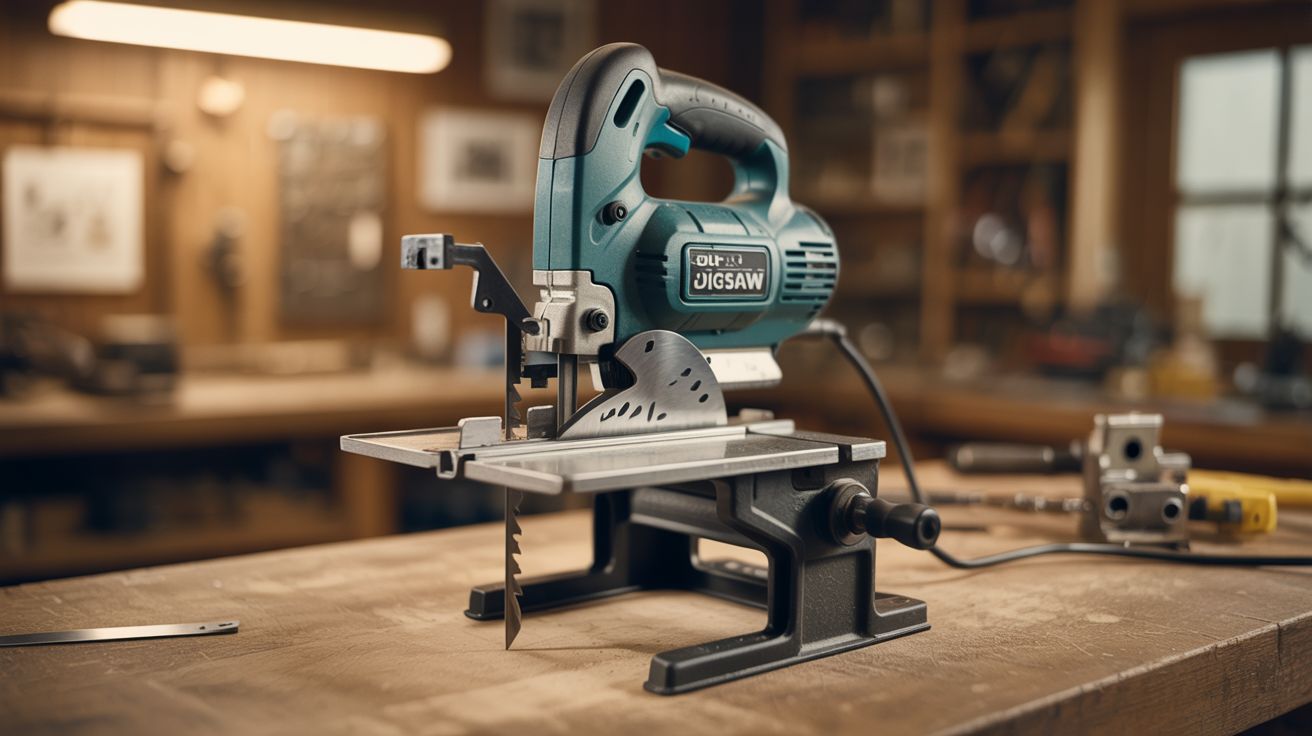
Jigsaw flipped upside-down under a table, blade through a slot. Feed the workpiece into the blade. $30 jigsaw, $200 scroll saw.
Ratings


🧪 What Is It?
A scroll saw is a jigsaw mounted to a table. That's the entire concept. A scroll saw holds a thin blade under tension and moves it up and down while you guide a workpiece across a flat table into the blade. A jigsaw does the exact same thing — reciprocating blade, thin kerf, cuts curves — except you hold it in your hand. Flip the relationship: mount the jigsaw upside-down under a flat table, poke the blade up through a slot, and now the blade is stationary while your hands are free to guide the workpiece from above. You've just converted a $30 jigsaw into a $200 scroll saw.
The conversion takes under an hour. The jigsaw bolts to the underside of a plywood table via its base plate. The blade sticks through a narrow slot. Clamp the trigger on (or wire through a foot switch), set the workpiece on the table, and push it into the blade. Both hands guide the material, letting you cut tight curves, intricate shapes, letters, puzzle pieces, ornamental fretwork, wooden toys, holiday ornaments, and custom signs. People sell this kind of work at craft fairs for $20-80 per piece.
Two things a real scroll saw does better: blade tension (scroll saw blades are tensioned top and bottom, reducing deflection and allowing hair-thin blades) and throat depth (distance from blade to frame, limiting workpiece size). Your conversion has no upper blade support, so the blade can flex on tight curves in thick material. For thin plywood (1/4" to 1/2"), soft metals, and plastic under about 12" wide, none of that matters — it cuts beautifully. If you discover you love scrollwork, you'll eventually want a dedicated saw. But this gets you started for free to find out.
🧰 Ingredients
- Jigsaw — any brand, variable speed preferred (already own or thrift store, ~$15-30 used)
- 3/4" plywood — about 24"x20" for the table surface, smooth one side (scrap pile or hardware store, ~$8)
- 2x4 lumber — for legs or clamping frame, about 6 feet (scrap pile)
- Scroll-cut or fine-tooth jigsaw blades — thinner = tighter curves, 10-20 TPI (hardware store, ~$5-10)
- Bolts (1/4"-20 x 1.5"), washers, lock nuts — for mounting the jigsaw (hardware store, ~$3)
- Countersink bit — to recess bolt heads flush with the table (hardware store, ~$4)
- Zip ties or trigger clamp — to lock the jigsaw trigger (junk drawer)
- Paste wax — for slick table surface (hardware store, ~$6)
- Spray adhesive — for attaching paper patterns to workpieces (hardware store, ~$5)
- Optional: foot switch — inline power switch for hands-free on/off (hardware store, ~$10-15)
- Optional: LED clamp light — good visibility at the cut line is essential (already own)
- Optional: stiff wire (coat hanger gauge) — for a hold-down arm (junk drawer)
- Optional: shop vac — dust collection at the blade slot (already own)
- Wood screws (workshop)
🔨 Build Steps
-
Build the table top. Cut 3/4" plywood at least 24"x20". Sand the top face to 220 grit — any roughness catches thin workpieces. Apply two coats of paste wax, buffing between coats. The wax lets even paper-thin plywood glide without resistance.
-
Mark the blade position. Set the jigsaw upside-down on the underside. Position so the blade comes through roughly centered left-to-right, about 8-10" from the front edge. This gives you support surface behind and to both sides of the blade for maneuvering large workpieces. Trace the blade location (top and bottom of stroke) and the base plate bolt holes.
-
Cut the blade slot. Drill a 1/4" starter hole and widen into a narrow slot — about 1/4" wide and 2" long. Keep it tight. A sloppy wide slot lets cutoffs fall through and jam the mechanism, reduces workpiece support at the cut point, and hurts dust evacuation.
-
Drill and countersink mounting holes. Drill 1/4" bolt holes matching the jigsaw's base plate holes. Countersink the table's top surface so bolt heads sit completely flush. Proud bolt heads catch workpieces and gouge the underside of your material. Run your hand across — you should feel nothing.
-
Mount the jigsaw. Bolt it upside-down to the underside: bolts from the top, flat washer and lock nut on the bottom. The base plate must pull flat against the table with zero gap — any gap angles the blade off perpendicular. Cycle the blade stroke by hand (unplugged) and confirm it clears the slot edges throughout.
-
Build the support frame. Elevate the table so the jigsaw hangs freely underneath with 4-5" clearance. Option A: standalone bench with four 2x4 legs at seated elbow height (scroll work is a sitting activity). Option B: U-shaped cradle that clamps to your workbench with the jigsaw hanging off the front edge. Either way, add diagonal bracing or corner gussets — a jigsaw produces serious vibration, and a rigid frame absorbs it instead of amplifying it.
-
Lock the trigger. Use the jigsaw's built-in trigger lock if it has one. Otherwise zip-tie the trigger on. Best option: wire the power cord through an inline foot switch. Step on to start, lift to stop. A foot switch gives you instant hands-free kill power and lets you stop the blade while repositioning workpieces.
-
Install a blade. Use the thinnest blade your jigsaw accepts. Standard T-shank blades work; actual scroll saw blades (if your chuck fits them) cut dramatically tighter radii. For wood under 1/2": 10-15 TPI. For metal or hard plastic: 18-24 TPI. Insert with teeth pointing upward toward the table surface — this pulls the workpiece down during cutting, keeping it flat and reducing chatter.
-
Build a hold-down arm (recommended). Thin workpieces bounce on the blade's upstroke, producing rough cuts. Bend stiff wire or spring steel into an L-shaped arm that presses lightly on the workpiece just ahead of the blade. Mount the base to a post behind the blade slot. Adjust height for gentle pressure — enough to keep material flat, not so much it's hard to slide.
-
Add a dust port (recommended). Cut a 1.5" hole behind the blade slot and mount a PVC pipe fitting. Connect your shop vac. The reciprocating blade pumps sawdust straight at your face with every stroke. A dust port catches most of it. MDF dust in particular is nasty — don't breathe it.
-
Test cut. Power on at low speed. Feed scrap 1/4" plywood into the blade with both hands — fingertips on top, pushing gently. Try a gradual curve, then a tight one. If the blade deflects badly, slow your feed rate or switch to a thinner blade.
-
Practice interior cuts. For pierced work, drill a starter hole in the waste area. Remove the blade from the chuck, thread it through the hole from below, reattach in the chuck, and cut the interior shape. More fiddly than a real scroll saw's 5-second blade change, so batch your drilling first, then do all threading and cutting.
-
Dial in speed and orbital settings. Low speed for tight curves and delicate materials. Medium for general scrollwork. High for straight runs in thick hardwood. If your jigsaw has orbital action (lever numbered 0-III), set it to 0 for all scroll work. Orbital action makes cuts faster but rougher and less precise — save it for when the jigsaw goes back to being handheld.
-
Transfer patterns and start making things. Print your pattern on paper, spray-glue it to the workpiece, cut along the lines. Peel the paper after (a hair dryer softens stubborn adhesive) and sand edges with 220 grit. For repeatable work, make hardboard templates. The internet has thousands of free scroll saw patterns ready to print. Start simple — a Christmas ornament, a name cutout — and work up to stacked fretwork and 3D puzzles.
⚠️ Safety Notes
-
Keep fingers at least 2 inches from the blade at all times. A jigsaw blade is wider than a scroll saw wire blade and causes deep lacerations. Use a push stick for small pieces. Never push anything smaller than 2"x2" freehand.
-
Secure the trigger and power before starting. With a zip-tied trigger, the only way to stop is unplugging or hitting a foot switch. Make absolutely sure you can kill power quickly. A foot switch is strongly recommended.
-
Wear safety glasses every time. The upward-cutting blade throws dust and chips at your face each stroke. For MDF, particle board, or treated lumber, add a dust mask — the chemicals in those materials produce harmful dust.
-
Clamp the table or verify the frame is stable. Jigsaw vibration walks an unsecured table across the bench over time. A table that shifts mid-cut brings your hands closer to the blade than intended.
-
Check blade mounting before powering on. A blade that pops loose from the chuck ejects through the table slot. Tug firmly — it should feel seated with zero play.
-
Do not force the cut. Pushing faster than the blade can cut causes flex, heat buildup, and blade breakage. Broken jigsaw blades are sharp and hot. Let the blade set the pace.