#115 — Permanganate Auto-Ignition
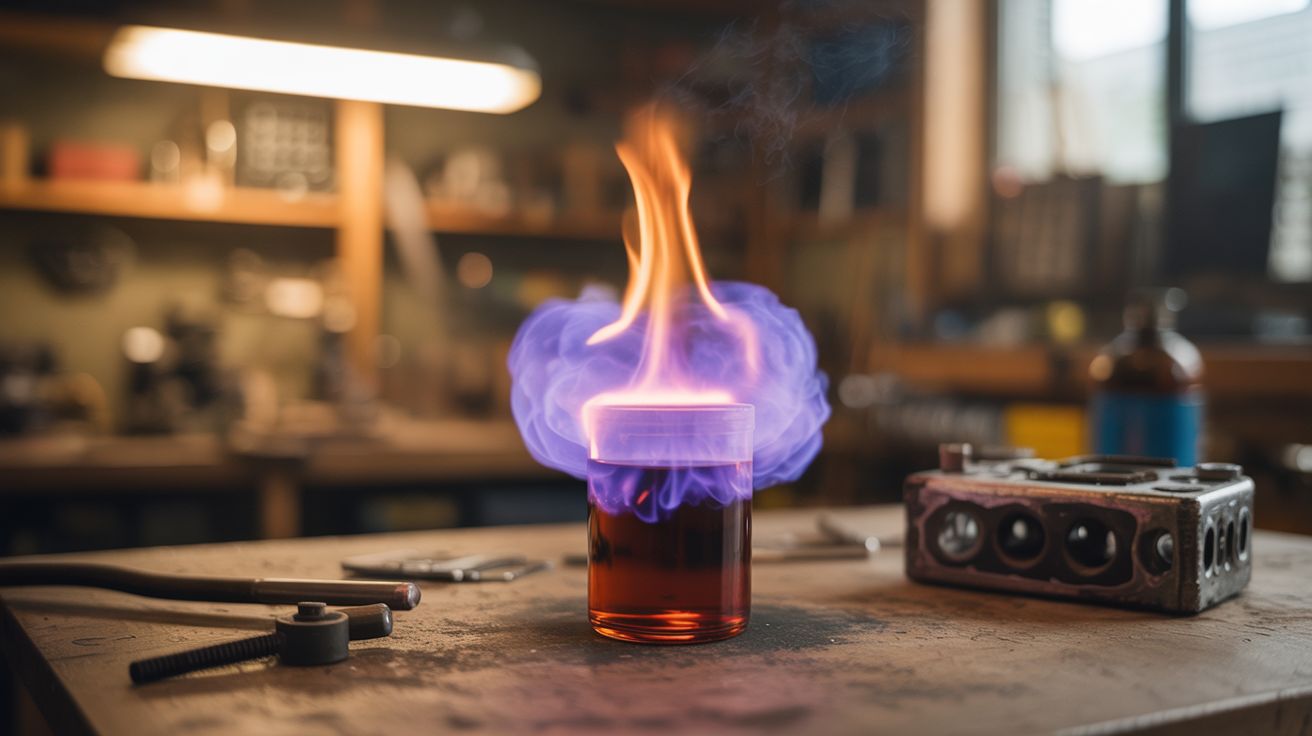
Potassium permanganate meets glycerin — 30 seconds of anticipation, then spontaneous purple flames.
Ratings



🧪 What Is It?
Potassium permanganate is a powerful oxidizer. Glycerin is a thick, syrupy fuel. When you pour glycerin onto a pile of potassium permanganate powder, nothing happens immediately. Then, after a 30-60 second delay, the exothermic oxidation reaction reaches ignition temperature and the mixture spontaneously bursts into vivid purple-tinged flames. No spark, no match, no lighter — just two liquids/powders meeting and chemistry taking its course. The delay is what makes it spectacular. You pour the glycerin, step back, and wait. The anticipation builds. Then — fire from nothing. It's the most dramatic demonstration of chemical auto-ignition you can do with hardware store ingredients.
🧰 Ingredients
- Potassium permanganate (KMnO4) — purple crystals (water treatment supplier, online, some hardware stores)
- Glycerin (glycerol) — pharmaceutical grade (pharmacy, craft store — sold as soap-making ingredient)
- Fireproof surface — ceramic plate, metal tray, concrete (workshop, outdoors)
- Long-handled pipette or squeeze bottle — for applying glycerin from a distance (pharmacy, online)
- Safety goggles (hardware store)
- Fire-resistant gloves (hardware store)
🔨 Build Steps
- Set up outdoors. This must be done on a non-flammable surface in an outdoor area. Use a ceramic plate, metal tray, or concrete pad. Clear the area of any flammable materials within a 5-foot radius.
- Create the permanganate mound. Pour a tablespoon of potassium permanganate into a small mound on the fireproof surface. Shape a small well or depression in the center of the mound to hold the glycerin.
- Position yourself for the pour. Use a long-handled pipette, squeeze bottle, or simply a cup held at arm's length. You want to pour the glycerin and step back, because the ignition timing is not perfectly predictable — it can range from 20 seconds to over a minute depending on temperature and particle size.
- Add the glycerin. Pour approximately 1 teaspoon of glycerin into the well in the permanganate mound. Do not stir. Step back immediately to at least 5 feet.
- Watch and wait. The glycerin begins reacting with the permanganate immediately, but slowly. You'll see the mixture darken and start to smoke. The reaction accelerates as it heats up — it's autocatalytic, meaning the heat produced speeds up the reaction, which produces more heat.
- Observe the auto-ignition. After 30-60 seconds, the mixture reaches ignition temperature and bursts into flame. The flames are tinged purple from the potassium, and the reaction produces considerable smoke. The flame is vigorous but brief — it burns out in about 10-15 seconds.
- Experiment with variables. Finer permanganate powder ignites faster. Warmer ambient temperature shortens the delay. More glycerin produces a larger flame. The delay can be extended by using less glycerin or coarser crystals.
- Film in slow motion. The moment of auto-ignition — where smoke transitions to flame — is incredibly cinematic in slow motion. Set up a camera at a safe distance before pouring the glycerin.
⚠️ Safety Notes
Spicy Level 4 build. Read the Safety Guide and Chemical Safety, Fire & Pyro Safety before starting.
- Potassium permanganate is a powerful oxidizer and stains everything it contacts a deep purple/brown. Wear gloves and old clothes. The stains on skin fade in a few days but are nearly impossible to remove from fabric.
- The auto-ignition delay is variable and unpredictable. Never lean over the mixture to check on it. Always step back after adding glycerin and observe from a safe distance. On hot days, ignition can occur in under 20 seconds.
- Potassium permanganate is harmful if ingested and irritating to eyes and respiratory tract. Handle in well-ventilated areas. Store away from all organic materials (wood, paper, cloth) as it is an oxidizer that can spontaneously ignite flammable materials in concentrated form.