#117 — Glow Resin River Table
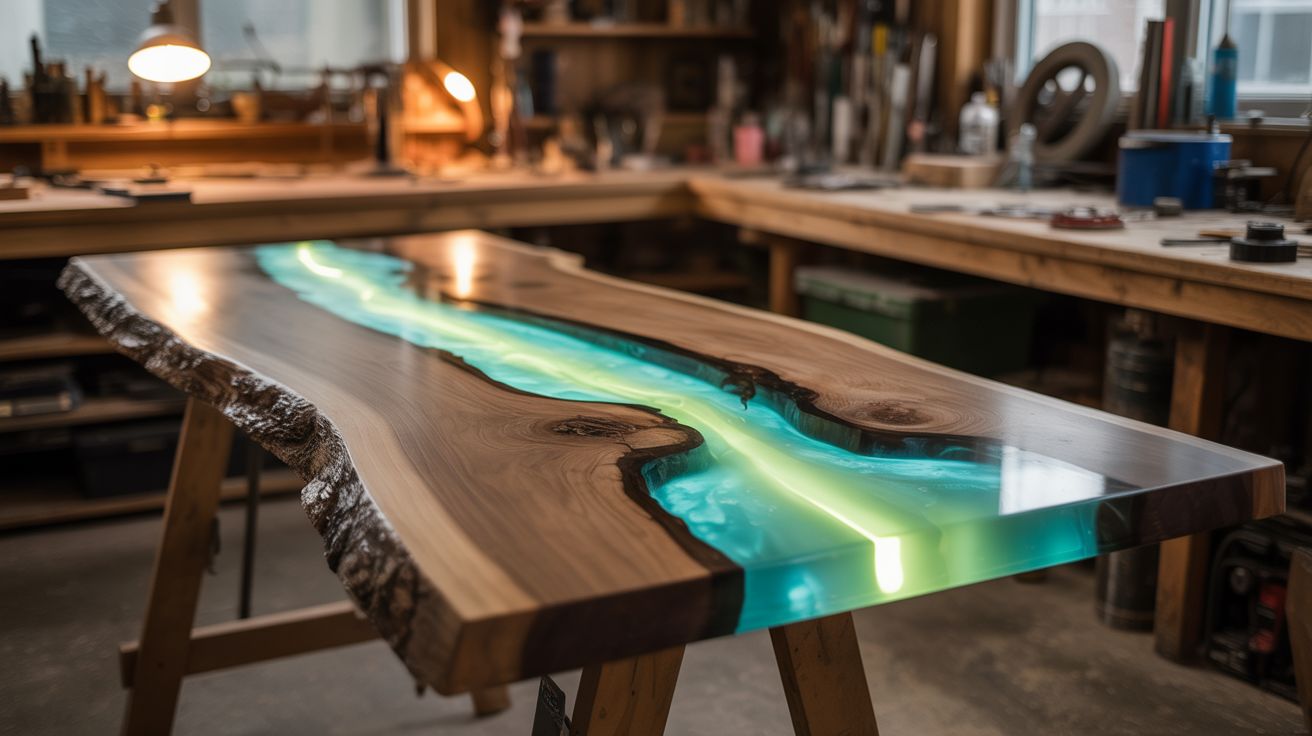
Glow-in-the-dark pigment in epoxy resin poured into a live-edge wood slab — a table that glows for 12+ hours.
Ratings






🧪 What Is It?
River tables are live-edge wood slabs split down the middle with a "river" of clear epoxy resin flowing between the two halves. They sell for $500-2000+ on Etsy. Now add strontium aluminate glow pigment to the resin. During the day, the table looks like a beautiful clear-river table. But charge it with sunlight or room light, kill the lights, and the river glows an intense blue-green for 12+ hours. Strontium aluminate is the strongest commercially available phosphorescent pigment — it's not like cheap glow paint that fades in minutes. This stuff BLAZES in the dark and keeps going all night. The combination of natural wood grain and a glowing river between the halves is otherworldly.
🧰 Ingredients
- Live-edge wood slab — walnut, maple, or similar hardwood, split or with a natural void (lumber yard, online slab dealers, Craigslist)
- Epoxy resin — deep pour formula (cures in thick layers without overheating) (craft supply, online)
- Strontium aluminate glow pigment — aqua/blue-green is brightest, 100-200 grams (online specialty supplier)
- Plywood and melamine — for building the mold (hardware store)
- Silicone caulk — to seal mold edges (hardware store)
- Mold release wax or tape — prevents resin from bonding to mold (craft supply)
- Sandpaper — 80 through 2000 grit (hardware store)
- Orbital sander (workshop)
- Table legs — hairpin legs, steel pipe, or custom (hardware store, online)
- Mixing buckets, stir sticks, nitrile gloves, respirator (hardware store)
🔨 Build Steps
- Prepare the wood slab. If using a single slab, split it or route a river channel down the middle. If using two halves, arrange them bark-edge-inward with a river gap of 3-6 inches. Sand the surfaces to 120 grit. Seal the wood with a thin coat of epoxy to prevent bubbles from off-gassing during the main pour.
- Build the mold. Create a melamine or plywood box that fits snugly around the slab with walls extending above the highest point. The mold bottom and walls should be covered in mold release wax or packing tape so the cured resin releases cleanly. Seal all edges with silicone caulk — any gap leaks resin.
- Secure the slab in the mold. Place the wood slab in the mold and clamp or screw it in position. The bark edges should face inward toward the river gap. Check with a level — the mold must be perfectly level or the resin river will be uneven.
- Mix the glow pigment into resin. Mix your deep-pour epoxy according to the manufacturer's ratio. Add strontium aluminate powder at roughly 1 part pigment to 3-5 parts resin by volume. Stir thoroughly for at least 3 minutes. The pigment is dense and tends to settle, so thorough mixing is critical.
- Pour the resin. Pour the glow resin into the river gap slowly to minimize air bubbles. For gaps deeper than 1 inch, pour in multiple layers, allowing each layer to partially gel before adding the next (follow your epoxy's maximum pour depth). Use a heat gun or torch to pop surface bubbles.
- Stir periodically during cure. Strontium aluminate pigment is heavier than resin and settles over time. For the first hour, periodically stir the resin in the mold to redistribute the pigment. After the resin begins to gel, the pigment stays in place.
- Cure and demold. Let the resin cure fully (24-72 hours depending on product). Remove the mold walls and peel off the melamine bottom. You now have a raw slab with a glowing river.
- Sand and finish. Flatten the surface with an orbital sander starting at 80 grit, progressing through 120, 220, 400, 800, 1200, and 2000 grit. The resin should be perfectly clear and glass-smooth. Apply a final coat of clear epoxy or polyurethane to the entire surface for protection.
- Attach legs. Mount hairpin legs, steel pipe legs, or custom fabricated legs to the underside. Use threaded inserts in the wood for the cleanest attachment.
- Test the glow. Charge the table by placing it in sunlight or under bright room lights for 15-30 minutes. Kill the lights. The river should glow intensely for 2-4 hours at full brightness, then continue glowing dimly for 12+ hours.
⚠️ Safety Notes
- Epoxy resin fumes are irritating and potentially sensitizing. Always work in a well-ventilated area or wear a respirator with organic vapor cartridges. Once cured, epoxy is inert and safe.
- Uncured epoxy is a skin sensitizer — repeated exposure without gloves can cause permanent allergic reactions. Always wear nitrile gloves. If resin contacts skin, wash with soap immediately (not solvents).
- Deep resin pours generate significant heat (exothermic reaction). Pouring too deep too fast can cause the resin to overheat, crack, yellow, or even smoke. Follow the manufacturer's maximum pour depth strictly.