#150 — Fractal Laser Engraver
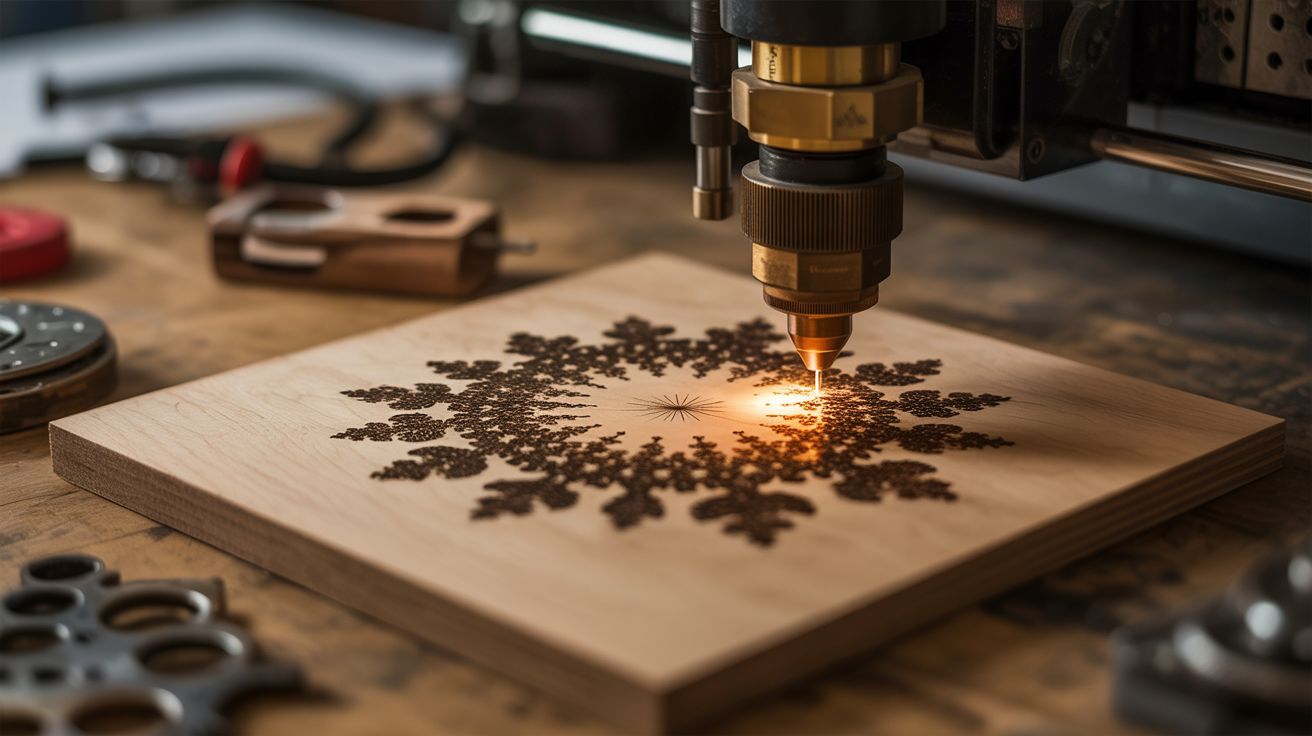
Render Mandelbrot and Julia fractals at extreme resolution in Python, then burn them into wood or leather with a laser engraver.
Ratings






🧪 What Is It?
Fractals are infinitely detailed mathematical structures — the Mandelbrot set, Julia sets, Sierpinski triangles, Koch snowflakes. Rendered at extreme resolution, they contain an infinite amount of detail: spirals within spirals within spirals. Now burn them into physical material with a laser engraver. The laser's power modulation maps to the grayscale of the fractal image — darker areas get more burn, lighter areas get less. The result is mathematical art permanently etched into wood, leather, or anodized aluminum. Each piece is literally a visual representation of an equation, burned into matter with coherent light. Math, physics, and art fused into a single object.
🧰 Ingredients
- Computer with Python and numpy (already own)
- Laser engraver — diode laser (5W+) or CO2 laser (electronics supplier, ~$200 for entry-level diode)
- Wood blanks — birch plywood, basswood, or maple coasters (craft store, hardware store)
- Leather pieces — vegetable-tanned leather engraves best (craft store)
- Python with numpy, PIL/Pillow, numba (for speed) (pip install)
- Laser control software — LaserGRBL or LightBurn (free/paid software)
- Safety goggles — rated for your laser wavelength (laser supplier)
- Ventilation — fume extractor or outdoor setup (hardware store)
🔨 Build Steps
- Write the fractal renderer. Use Python with numpy to calculate Mandelbrot or Julia sets. For each pixel, iterate the equation z = z² + c and count how many iterations before the value escapes. Map iteration count to grayscale. Use numba's @jit decorator for 100x speedup.
- Explore interesting regions. The beauty of fractals is in the edge regions. Zoom into the boundary of the Mandelbrot set to find spirals, seahorses, elephant valleys, and mini-brots. Adjust the coordinate window and maximum iteration count to find stunning compositions.
- Render at engrave resolution. Laser engravers typically work at 250-500 DPI. For a 6x6 inch piece, you need 1500x1500 to 3000x3000 pixels. Render the fractal at this resolution. Save as a high-quality PNG with full grayscale range.
- Post-process the image. Adjust contrast and brightness for the specific material. Wood needs more contrast than leather. Invert if needed (lasers burn dark, so dark pixels = more burn). Apply a slight Gaussian blur to prevent the laser from chasing single-pixel noise.
- Set up the laser engraver. Mount the material on the engraver bed. Focus the laser at the material surface. Import the fractal image into LaserGRBL or LightBurn. Set power, speed, and DPI parameters for a test area.
- Test engrave. Run a small section (1x1 inch) to calibrate. Adjust power (too high = charring, too low = faint image) and speed (slower = darker/deeper). Different materials need different settings — wood, leather, and anodized aluminum each respond differently.
- Full engrave. Once settings are dialed in, run the full image. Large pieces at high resolution can take 30-90 minutes. Watch the first few passes to verify quality, then let it run. The fractal builds up line by line.
- Finish the piece. Sand lightly if there's smoke residue on wood. Apply a clear coat or finishing oil to enhance contrast and protect the engraving. For coasters, apply a food-safe sealant. Frame pieces for wall display.
- Create a series. Generate a sequence of images zooming progressively into one region of the fractal. Engrave each zoom level on a separate piece for a gallery installation showing infinite zoom in physical form.
⚠️ Safety Notes
- Laser engravers produce invisible beams that cause INSTANT permanent eye damage. Always wear safety goggles rated for your laser's wavelength (typically OD5+ at 445nm for diode lasers, OD5+ at 10600nm for CO2). Never look at the laser dot without goggles.
- Laser engraving produces toxic fumes, especially on wood (smoke), leather (burned protein), and plastics (toxic gases). Always operate with active ventilation — a fume extractor or outdoors. Never engrave PVC or vinyl, which release chlorine gas.
- Keep a fire extinguisher nearby. Wood and leather can ignite if the laser dwells too long in one spot (due to a software glitch or mechanical jam). Never leave a running laser engraver unattended.