#317 — Crystal Radio
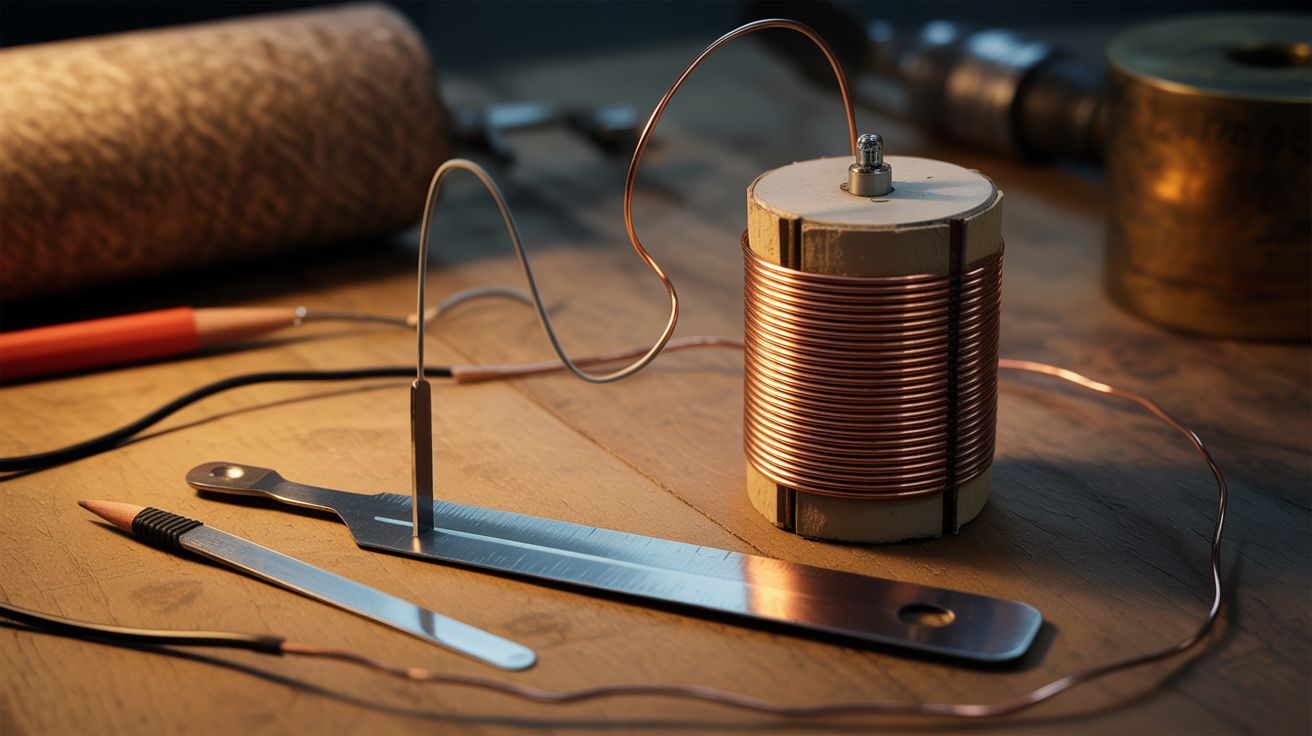
Zero batteries. Zero power source. Receives AM radio from pure electromagnetic energy harvested from the broadcast signal itself.
Ratings




🧪 What Is It?
A radio receiver that uses no batteries and no external power source of any kind. A long wire antenna captures AM radio waves. A hand-wound coil paired with a variable capacitor forms a tuned circuit that selects a single station from the electromagnetic soup. A diode — or, for maximum junkyard credibility, a razor blade touched by a pencil lead acting as a crude semiconductor junction — demodulates the AM signal, stripping away the carrier frequency and leaving only the audio. A high-impedance crystal earpiece converts that audio signal into sound. The energy to drive the earpiece comes entirely from the broadcast signal itself. The radio station's transmitter, possibly dozens of miles away, is providing your power.
This is how radio worked in 1906. Guglielmo Marconi's original receivers used a "cat's whisker" detector — a thin wire touching a galena crystal, which forms a natural point-contact diode. You can replicate this with a razor blade and the tip of a pencil lead (graphite). The graphite-on-steel contact creates a crude metal-semiconductor junction that rectifies the signal just enough to extract audio. Finding the "sweet spot" on the blade where rectification works best is part of the experience — it's the original user interface, and it requires the patience of a safecracker. Alternatively, a modern germanium diode (1N34A) does the same job perfectly every time, but where's the fun in that?
The sound is quiet — you'll need a crystal earpiece, not regular earbuds or a speaker, because crystal earpieces are high-impedance and extract maximum audio from the tiny signal. But the fact that you're hearing a human voice transmitted from miles away using nothing but wire, a razor blade, and a toilet paper tube is genuinely magical. This is the ultimate survival radio. No power grid, no batteries, no solar panel, no charging cable. Just physics, copper wire, and your ability to wind a coil.
🧰 Ingredients
- Magnet wire — 24-28 AWG, about 50 feet (dead motor or transformer winding — free from e-waste)
- Cardboard tube — toilet paper roll or paper towel roll (recycling bin, free)
- Germanium diode (1N34A) — or a razor blade + pencil lead for a cat's whisker detector (electronics bin, ~$0.50 — or kitchen drawer, free)
- Crystal earpiece — high-impedance ceramic or piezoelectric earpiece (~$3 online, or salvage a piezo buzzer from an old smoke detector and add an ear tube)
- Wire for antenna — any long wire, 20-50 feet; speaker wire, fence wire, or any insulated wire works (garage, free)
- Ground connection — cold water pipe, metal ground rod, or a metal stake driven into damp earth (already available or hardware store, ~$3)
- Variable capacitor — salvage from an old AM radio (free from e-waste — or build one from alternating aluminum foil and paper plates)
- Alligator clips and hookup wire — for making connections (electronics bin, ~$2)
- Small capacitor, 100pF-1nF — for filtering (electronics bin, free)
🔨 Build Steps
-
Wind the tuning coil. Wrap 60-80 turns of magnet wire tightly around the cardboard tube. Keep the turns close together and even — no gaps or overlaps. Leave 6-inch wire tails at each end for connections. Optionally, make taps (small loops pulled out from the coil) every 15-20 turns. These taps allow you to coarse-tune the inductance by selecting different portions of the coil, which changes the frequency range.
-
Connect the variable capacitor. Wire the variable capacitor in parallel with the coil (one lead to each end of the coil winding). Together, the coil and capacitor form a resonant LC circuit. The resonant frequency is f = 1 / (2pi * sqrt(LC)). Turning the capacitor changes the capacitance, which shifts the resonant frequency, tuning the circuit to different AM stations. If you don't have a variable capacitor, you can build a crude one: interleave sheets of aluminum foil separated by paper or plastic wrap, and slide the foil sheets to vary the overlap area.
-
Connect the detector. Wire the diode from the top of the coil to one terminal of the earpiece. If using a 1N34A germanium diode, observe polarity (the banded end toward the earpiece). If building a cat's whisker detector: mount the razor blade flat on a small board with a thumbtack or screw holding it down. Sharpen a pencil to expose the graphite tip. Mount the pencil in a clip or holder so the graphite tip touches the blade surface at a slight angle. You'll need to experiment to find the spot on the blade where rectification occurs — press gently, move the contact point around, and listen for audio in the earpiece.
-
Add the filter capacitor. Connect a small capacitor (100pF to 1nF) in parallel with the earpiece. This filters out the residual carrier frequency, passing only the audio signal. Without it, you may hear a harsh buzz mixed with the audio.
-
String up the antenna. Run 20-50 feet of wire as high as you can get it, outdoors. Drape it over a tree branch, run it along a fence top, or hang it from the roof. The antenna is the single biggest factor in signal strength — longer and higher means louder reception. Connect one end to the top of the tuning coil. The other end hangs free.
-
Connect the ground. Clip a wire from the bottom of the tuning coil to a ground connection. The best ground is a cold water pipe (copper plumbing). A metal stake or rod pushed into damp earth works. A wire connected to a radiator or metal fence post also works. The ground completes the circuit — without it, you'll hear almost nothing.
-
Tune and listen. Put in the crystal earpiece. Slowly rotate the variable capacitor. At each AM station's frequency, you'll hear audio fade in, peak in clarity, and then fade out as you tune past. Nearby AM stations with strong transmitters will come through clearly. Distant stations will be faint but audible, especially on quiet nights when AM signals bounce off the ionosphere and travel hundreds of miles. If using the cat's whisker, you may need to readjust the contact point when changing stations.
⚠️ Safety Notes
- Zero electrical danger. The voltage in the circuit is measured in millivolts — far below any level that could cause harm.
- The loudest possible signal from a nearby AM tower is still barely audible through the crystal earpiece. No hearing damage risk.
- The only physical hazard is the razor blade if you're building the cat's whisker detector. Handle it carefully during setup and mount it securely so it doesn't slide around.