#077 — Cyclone Dust Separator
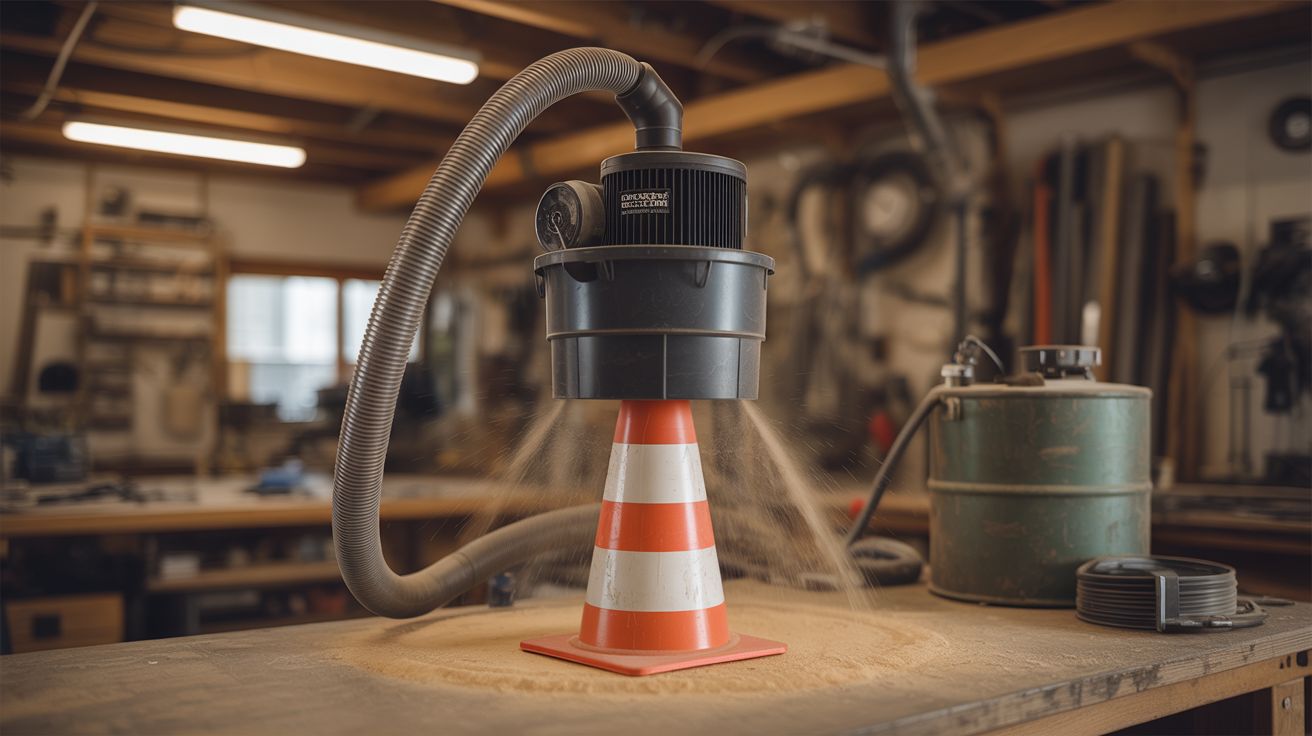
Vacuum motor + bucket + traffic cone + PVC pipe. Cyclonic separation catches 99% of dust before it hits the shop vac filter. Filter lasts forever.
Ratings


🧪 What Is It?
Cyclonic separation uses centrifugal force to separate particles from an air stream — the same principle Dyson made a fortune on. Dirty air enters a cone-shaped chamber tangentially (at an angle), creating a spinning vortex. Heavy particles (sawdust, debris, drywall dust) are flung to the outer wall and spiral downward into a collection bin. Clean air exits from the top center through a smaller tube. By placing a cyclone separator between your dust source and your shop vac, you catch 99% of material before it ever reaches the filter. The filter stays clean almost indefinitely, suction remains strong, and you can dump the collection bucket instead of wrestling with messy filter bags. Build one from a 5-gallon bucket and a traffic cone for almost nothing.
🧰 Ingredients
- 5-gallon bucket with lid (hardware store or free from restaurants)
- Traffic cone or large funnel — forms the cyclone cone shape (thrift store, roadside, hardware store)
- PVC pipe — 2" diameter, for inlet and outlet (hardware store)
- PVC elbow fittings (90-degree) — for tangential inlet (hardware store)
- Shop vacuum or vacuum motor — provides the suction (already own or dead vacuum)
- Silicone caulk or hot glue — for sealing joints (hardware store)
- Hole saw or jigsaw — for cutting holes in the bucket lid (workshop)
🔨 Build Steps
- Prepare the bucket lid. Cut two holes in the 5-gallon bucket lid: one near the edge for the air inlet pipe, and one in the center for the air outlet pipe. The center outlet connects to your shop vac (clean air out). The edge inlet connects to your dust hose (dirty air in).
- Cut the traffic cone. Cut the tip off the traffic cone to create an opening at the narrow end (about 2-3 inches diameter). Cut the wide base end so it fits snugly inside the bucket just below the lid. The cone should hang from the lid with the narrow end pointing down into the bucket.
- Install the inlet pipe. Mount a 2" PVC pipe through the edge hole in the lid and through the top wall of the traffic cone. The pipe must enter the cone tangentially — at an angle that directs airflow along the inner wall of the cone, not toward the center. This tangential entry creates the cyclone vortex.
- Install the outlet pipe. Mount a 2" PVC pipe through the center hole in the lid, extending down into the cone about 2-3 inches. This center tube is called the "vortex finder" — clean air spirals up and exits through this tube while dirty air spins around the outside.
- Seal all joints. Use silicone caulk or hot glue to seal around every pipe penetration and the cone-to-lid connection. Air leaks destroy the cyclone vortex and reduce separation efficiency. Every joint must be airtight.
- Attach the cone to the lid. Glue or screw the wide end of the traffic cone to the underside of the bucket lid. When the lid snaps onto the bucket, the cone hangs inside with the narrow end pointing down, leaving space at the bottom of the bucket for collected dust.
- Connect to the shop vac. Attach a hose from the center outlet pipe to your shop vac intake. Attach your dust collection hose (from sander, saw, or floor sweep) to the tangential inlet pipe. The shop vac provides suction that pulls air through the entire system.
- Test the system. Turn on the shop vac and sweep up some sawdust or dirt. Open the bucket after a few minutes — debris should be collected in the bottom of the bucket, NOT in the shop vac filter. If dust is reaching the filter, check for air leaks or adjust the tangential inlet angle.
⚠️ Safety Notes
- Fine dust (drywall, MDF, hardwood sanding dust) is a serious respiratory hazard even with a cyclone separator. The cyclone catches most particles, but the finest dust still passes through. Always run the shop vac with its own filter behind the cyclone, and consider wearing a respirator during heavy dust work.
- The bucket must be securely sealed to the lid. If the lid pops off during operation, the cyclone vortex collapses and you get a face full of dust. Use a lid with a gasket and clamp, or tape the lid down.